
The Greek Golden Visa is the most accessible residency-by-investment program in Western Europe and as of 2026 the thresholds have settled into three tiers that determine where and how foreign investors can buy. This guide covers exactly what the minimum investments are, which property and asset types qualify, who can apply, and what the application timeline looks like in 2026.
Written for: non-EU buyers (US, UK, Canadian, Middle Eastern, Asian) considering Greek real estate investment with residency rights attached.
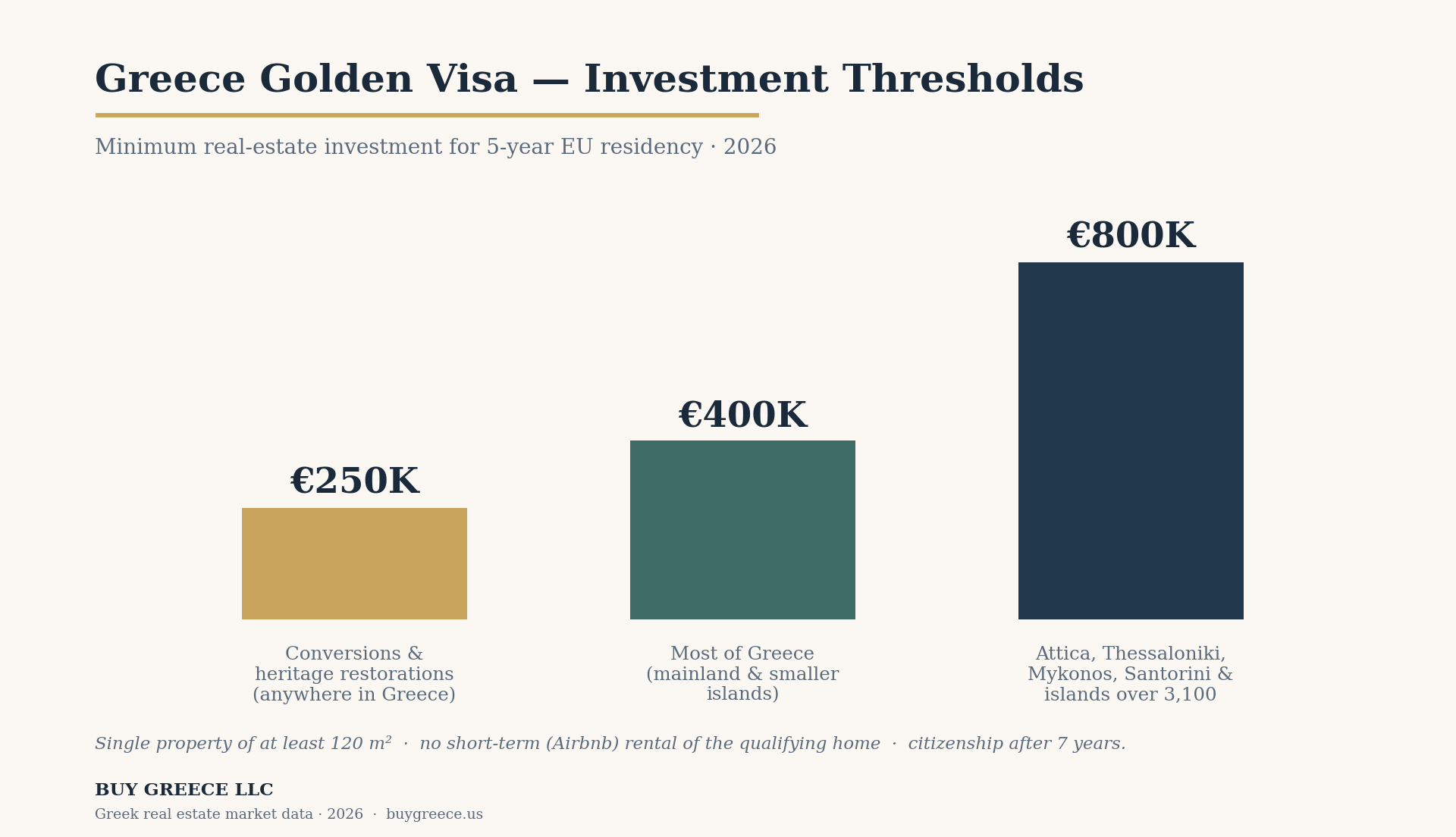
Greece Golden Visa 2026 - the 3 minimum investment thresholds
As of 2026, the Greek Golden Visa requires a minimum real estate investment of:
- €800,000 — in Athens metropolitan area, Thessaloniki metropolitan area, Mykonos, Santorini, and all Greek islands with population over 3,100 residents
- €400,000 — in all other Greek regions: most of the Peloponnese (including Kalamata and Nafplio), most of Crete, smaller islands (below 3,100 residents), inland mainland regions, northern Greece outside Thessaloniki metro
- €250,000 — only for two specific property categories: (a) commercial-to-residential conversions, and (b) properties classified as protected historic buildings (preserved monuments)
All three thresholds also require: minimum property size of 120 m², and the investment must be in a single property (you cannot stack multiple smaller properties to meet the threshold).
→ Free Golden Visa eligibility consultation with a US-licensed agency · BUYGREECE LLC has placed hundreds of US, UK, and international clients into Greek Golden Visa qualifying properties since 2018.
What the three tiers actually mean in practice
€800K tier — Athens metro + premium islands
Roughly 60% of all Golden Visa applications target this tier because the underlying property markets are the most liquid and the resale value is most assured. Typical purchases:
- 2–3 bedroom new-build apartment in Glyfada (~120–150 m², waterfront-adjacent) €800K–€1.2M
- Modern apartment in Vouliagmeni €1.2M–€2M+
- 3-bedroom modern villa in Voula Panorama €1.4M–€3M
- 2-bedroom apartment in Athens center (Kolonaki, Pangrati) €800K–€1.5M
- Cycladic villa in Mykonos Ano Mera or Tourlos —€1M–€2.5M
€400K tier Peloponnese, most of Crete, smaller islands
Best price-to-residency leverage. Typical purchases:
- Modern villa in Crete Chania/Apokoronas — €400K–€800K
- Restored Venetian house in Nafplio old town — €400K–€900K
- Coastal villa in Kalamata Verga or Mani — €400K–€1M
- Stone villa on Paros / Naxos / Corfu — €400K–€800K
€250K tier narrow eligibility
Limited inventory but the cheapest entry. Two paths:
- Commercial-to-residential conversion: Buy a former office, warehouse, or retail unit and renovate to residential. Common in Athens center (Plaka, Monastiraki former workshops) and Piraeus. Investment includes purchase + renovation, total must hit €250K minimum.
- Protected historic buildings: Pre-1900 buildings classified by the Greek Ministry of Culture as "preserved monuments." Found in Nafplio old town, Athens Plaka, Hydra, Symi, and various heritage villages. Renovation is heavily regulated but tax incentives often apply.
What you get the Greek Golden Visa benefits in 2026
- 5-year renewable Greek residency permit for the main applicant
- Same residency extended automatically to: spouse, dependent children under 21 (or under 24 if students), main applicant's parents, spouse's parents
- EU Schengen Area travel visa-free travel across 27 Schengen countries during the residency period
- No minimum stay requirement in Greece you don't have to live in Greece (or visit at all) to maintain the visa
- No tax residency triggered automatically you only become a Greek tax resident if you spend >183 days/year in Greece
- Path to Greek citizenship after 7 years of legal residency (separate naturalization process, requires Greek-language proficiency)
- Right to rent out the property your investment property can be rented short-term or long-term while you hold the visa
Greek Golden Visa requirements 2026 full eligibility checklist
You qualify for the Greek Golden Visa via real estate if ALL the following are true:
- You are a non-EU citizen (US, UK post-Brexit, Canadian, Israeli, Lebanese, Egyptian, Saudi, UAE, Chinese, Russian — all eligible)
- You purchase a qualifying Greek property at or above the applicable threshold (€250K / €400K / €800K depending on zone and property type)
- The property is at least 120 m² (gross area)
- You purchase the property in your personal name (not via a foreign company — though Greek holding companies are sometimes used and add complexity)
- You have no criminal record in your country of origin or in any country where you've lived (background check via FBI/national equivalent)
- You hold valid health insurance covering Greece (private international policy or Greek policy)
- You provide proof of investment funds — bank statements showing source of capital, clean fund origin per AML rules
The Greek Golden Visa real estate purchase timeline (2026)
- Weeks 1–4: Identify qualifying property + initial negotiation. Obtain Greek tax number (AFM, can be done remotely via Power of Attorney).
- Weeks 4–10: Legal due diligence on property title search, encumbrance check, planning permit verification, structural survey. Sign preliminary contract with 10% deposit.
- Weeks 10–14: Notary closing —full purchase price paid, 3.09% transfer tax paid, deed signed and registered at Cadastre. You now own the property.
- Weeks 14–22: File Golden Visa application with Greek Migration & Asylum Ministry. Required documents: title deed, Greek tax certificate, passport + biometric data, criminal background check, health insurance proof, fund-source documentation. Filing fee: €2,000 per main applicant + €1,000 per dependent.
- Weeks 22–34: Processing period. Greek authorities review, request clarifications, schedule biometric capture. You'll visit Greece once (or be visited by mobile biometric team in some EU consulates) to provide fingerprints and photo.
- Week 34–40: Residence permit card issued. Your 5-year Greek + Schengen residency is active.
Total: 8–10 months from property identification to residence card in hand.
Greek Golden Visa 2026 total cost breakdown
- Property transfer tax: 3.09% of purchase price (€12K on a €400K property; €25K on €800K)
- Notary fees: ~1.0–1.5% of price
- Legal/lawyer fees: 1.0–1.5% of price for full diligence + closing representation
- Cadastre registration: ~€500
- Real estate brokerage: 2% typically (in some cases paid by seller; in others split)
- Golden Visa application fee: €2,000 main applicant + €1,000 per dependent
- Health insurance: €500–€1,500/year per person
- Translation + apostille of foreign documents: €500–€2,000
Total transaction overhead: 5–7% on top of property purchase + ~€3,000–€8,000 in application/permit costs.
Which Greek Golden Visa tier is right for you?
- "I want the most liquid asset + best resale" → €800K tier in Athens Riviera (Glyfada, Voula) or Athens metro. Strongest secondary market.
- "I want the lowest entry point" → €400K tier in Crete (Chania/Apokoronas), Kalamata, or Nafplio. Real estate value-for-money is also highest in these regions.
- "I want a property I'll actually use" → Match the tier to where you'd want to spend time. Mykonos €800K + visa for summers; Crete €400K + visa for year-round Mediterranean base.
- "I want to minimize cost" → €250K conversion or historic-building tier — but be aware these require active renovation involvement and add complexity.
Common Golden Visa 2026 questions
What is the minimum investment for Greek Golden Visa in 2026?
€250,000 for conversion or historic-building tier (limited inventory); €400,000 for the mid-tier (most of mainland Greece outside Athens, most of Crete, smaller islands); €800,000 for Athens metro, Thessaloniki metro, Mykonos, Santorini, and large islands.
Can the Greek Golden Visa investment be split across multiple properties?
No — the qualifying investment must be in a single property of at least 120 m². You can own additional properties beyond the qualifying one, but the threshold must be met by one property alone.
Can I get Greek Golden Visa with €250,000 in 2026?
Only for two narrow categories: (a) commercial-to-residential conversions, and (b) protected historic monument buildings. The €250K tier no longer applies to standard residential property purchases as of late 2024.
What documents do I need for Greek Golden Visa requirements 2026?
Greek AFM tax number, property purchase deed, valid passport, biometric data, FBI/national criminal background check (apostilled and translated), health insurance certificate covering Greece, bank statements showing source of investment funds (typically 3–6 months), apostilled copies of birth/marriage certificates for dependents.
How long does the Greek Golden Visa take in 2026?
8–10 months from property identification to residence card in hand. About 14 weeks for property purchase, then 20–26 weeks for the Golden Visa application processing.
Do I need to live in Greece to keep the Golden Visa?
No. There is no minimum stay requirement. You can hold the visa for the full 5 years without spending a single day in Greece (though visiting is obviously the point for most buyers).
Can my family join me on the Greek Golden Visa?
Yes. The investment covers: main applicant, spouse, dependent children under 21 (under 24 if students), main applicant's parents, and spouse's parents. All receive 5-year renewable residency on one €400K–€800K investment.
What happens to my Golden Visa if I sell the property?
The residency permit is tied to maintaining the qualifying investment. Selling the property below the threshold (or selling entirely without replacing) terminates the visa. You can sell and replace with another qualifying property without losing residency status.
Start your Greek Golden Visa journey
BUYGREECE LLC is a Chicago-headquartered, US-licensed brokerage specializing in Golden Visa qualifying properties. We coordinate every step — property identification, AFM setup, legal due diligence, notary closing, and Golden Visa application filing — from our US office, entirely in English.
Browse Golden Visa-eligible properties by location:
→ Schedule a free Greek Golden Visa eligibility consultation
Reference pages from BUY GREECE, updated on a schedule and free to cite under CC BY 4.0:
Prices by region, rental yields and Golden Visa tiers, refreshed every quarter: Greek Property Monitor (prices, yields, Golden Visa tiers, quarterly)
Every Greek property rule change that affects buyers, dated and reviewed monthly: Greek property law tracker (every rule change, dated, monthly)
The full purchase process, the cost stack and where to buy: How do you buy property in Greece? The costs, the steps and the best areas
Model the return on a specific budget in a specific area, free and without signing up: Greek property ROI calculator (what your budget earns, by area, in rent and value)

How much do you need to invest for a Greece Golden Visa in 2026? The thresholds and requirements, zone by zone
Greek Golden Visa 2026: €250K, €400K, €800K tiers, eligibility, real estate rules, timeline & US buyer guide.



.jpg)
